Save old castle Lachlan
Home Page Lachlan TrustC Clan Society Membership 
Clan Information Members:Online Library  save old castle lachlan  


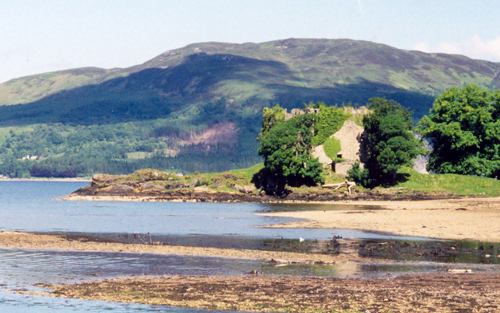
From History of the Chiefs:  The ruin of this medieval Castle surmounts a rocky knoll on the shore of Loch Fyne. Galleys could be drawn up on small shingle beaches on both sides of the promontory. Access to the sea was vital in Argyll. Manuscripts indicate that a Castle existed on the site in the late 13th century. This was a period when the Barons of Argyll and the Isles rose to prominence and named clans began to form. They embarked on the most remarkable collection of 13th century strongholds in Britain. Stone built castles on sea-girt rocks and bold promontories were a notable contrast to the earthwork and timber castles scattered across eastern and central Scotland.


  • The Celtic Era. This was the time when the Celtic kingdoms still existed in Ireland,   the Western Highlands  & the Isles ;  clans were being formed in Scotland. In 1242 Brian O'Neill, backed by the Norman Earl of Ulster and by the O'Donnells triumphed in battle and slaughtered King Domnhall MacLochlainn with ten of his immediate family, his chieftains and most of the adult MacLochlainn males; the MacLochlainns, for centuries Kings of Aileach and High Kings of Ireland, never again challenged their kinsmen the O'Neills for supremacy. Shortly  after the death of King Domnhall, the MacLochlainns of Cowal began to be recognized as a clan under their chief Lochlainn Mor ( Lachlan the Powerful). The Maclachlan of Maclachlan family is directly descended from this Lochlainn Mor. 
  •  After 1242 the Irish MacLochlainns were a broken clan; their lands on Inishowen peninsula were lost for ever . After being High Kings over six centuries, they were no more. About 25 years ago an Irish historian  maintained that some Irish records indicated that Lachlan Mor had fought for King Domnhal; that some MacLochlainns who fled from Inishowen took refuge with Lachlan Mor; that this became the nucleus of Clan Lachlan  in Scotland. In the conditions of the times this could have happened .  
  • Over the centuries there has been a  continuous interchange of people between Ulster and Argyll. The spelling of family names have changed depending on the country of residence.  McLaughlins of solely  Irish descent  share  a common Celtic and Irish  ancestry with the MacLachlans of Clan Lachlan and if they subscribe to the objectives  of a Scottish Highland  Clan Society are welcome and qualify as members.


  •  In  an unbroken line  for close to 750 years , old castle lachlan  takes us back to the days  of the Kingdoms of the Gael where in Ireland, Western Scotland and the Isles our ancestors lived by the 2,000 year old clan values and communal culture of the Celt . 


  • Scotland's War of Independance. The clan legend is that a  Castle was built by the Chief's Lady when the Chief was away in the Crusades.  From the records of the Scots  and the Crusades, the only candidate is the Eighth Crusade under Louis IX . This would put the starting date about 1270 and the Chief as Lachlan Mor and the Lady as one of the rich and powerful Carrick family.
  • This is supported by another  legend that the Lord of Castle Lachlan and the MacArthur , Laird of Strachur , vowed that  if either was killed on the Crusades the other would bring his body back. In later years in honour of this agreement they lowered the head of their neighbour at their funeral. MacArthur was on the Crusade and there is evidence that a Lachlan Mor was  one of the leaders of the Carrick men on the Crusade. The father of Robert Bruce and Prince Edward, later Edward I, distinguished themselves on this Crusade. 
  • The legend is that when Robert Bruce  in 1272 returned from the Crusades with the news of her husband's death, the redoubtable widowed Marjorie,  Countess of Carrick in her own right, detained  this virile Crusader until a marriage was consummated.; they had five sons and five daughters.  Their first son became Robert the Bruce, King of Scots. This was the period of William Wallace and Robert the Bruce when  Scotland was forged as a nation, independent of the Norman feudal system in England.


  • The Castle. There are records of the first castle in 1306 and 1314; the main structure of the existing "old castle lachlan" dates  probably to the late 14th and early 15th century; there will be some archaeological answers when the work of preservation is undertaken. 
  • The  old castle lachlan  has  been in continuous use for five hundred years as the residence of the Chiefs of Clan Lachlan . In the early  days of the 45 after Charles had landed, the Duke of Argyll, a friend, gave Lachlan the 17th Chief safe passage across Campbell lands to join the Prince's forces. This permission only applied to the outward journey!  During the 45, Castle Lachlan was occupied by Campbell militia as one of a chain of forts stretching to Fort William which protected Campbell lands; it played no part in the conflict. 
  • When the remnant of the clan struggled back to Loch Fyne after Culloden , warning of the Chief's fate was given by his horse which broke away and swam across the Loch on its own, arriving before the other survivors using the ferry. The last descendant of the family of the  ferryman who carried the clan across the Loch left the area in the 1950s. In 1790 the new castle lachlan, more correctly a baronial family residence,  was built by Donald,, the 19th chief.
  • Old castle lachlan  is a historic Scottish structure. For over seven hundred years it has been the gathering place for the Clan when the Chief sent the fiery cross round the glens. Our blood ancestors were there. The ancestors of many members of the clan emigrated over the last 250 years to Australia, Canada, New Zealand and the US.  Over the years the castle has been a "must pilgrimage"  for many  seeking their roots in Scotland. 


  • If the castle is to be there for future generations, we must act before it deteriorates into  a pile of stones.  Make a pledge and join  the SOCL Club . See  Lachlan TrustC


Web Master 

© 2010, the Clan MacLachlan Society  & the Lachlan Trust of Canada: Reg. 87231-0503-R0001